


Quick answer
Pros and cons of opening a branch office in Turkey vs. forming an LLC. Tax treatment, liability, profit repatriation and setup requirements compared.
Opening a Branch in Turkey: Advantages, Disadvantages, and Strategic Analysis
Introduction Entering the Turkish market offers significant opportunities for international corporations. However, your market entry strategy will have a direct impact on your success. The two most common methods are establishing a new subsidiary company (like an LLC or JSC) or registering a branch of your parent company.
While these two structures are often confused, they have vast differences, especially regarding legal liability and market perception.
In this guide, we will analyze what a branch office means in Turkey, when it is advantageous, and what critical disadvantages (particularly the “unlimited liability” principle) it carries.
What is a Branch Office in Turkey?
From a legal and commercial standpoint, a branch is not a separate legal entity.
A branch is merely an extension of the foreign parent company. It shares the same legal personality and operates in Turkey within the scope of the parent company’s field of activity. It has no independent existence; all its assets, debts, and obligations belong directly to the parent company.
This is the fundamental difference that separates it from a Limited Liability Company (LLC) or a Joint Stock Company (JSC), which are established as new “Turkish companies” with their own legal personality, separate from the parent. Compare structures in our LTD vs JSC guide.

The Advantages: Why You Might Open a Branch
Registering a branch can offer strategic advantages, especially in specific scenarios.
1. No statutory share-capital minimum A branch has no share capital of its own. That does not remove the registration, licensing, tax, employment and reporting work needed to operate in Turkey, and it should not be treated as a shortcut for a short market test.
2. Leveraging a Strong Parent Company Image If your parent company is a globally recognized and powerful brand, entering the market under that exact name provides a significant advantage. Clients and suppliers will feel more confident dealing with the direct branch of an international giant rather than a newly incorporated, unfamiliar “Ltd. Şti.” (LLC).
3. Operational and Financial Simplicity Since the branch is part of the parent company, internal processes like profit repatriation or financing (while still subject to reporting) can be operationally less complex. It is managed directly from the headquarters, ensuring full operational control.
The Disadvantages: The Most Critical Risks
The disadvantages of a branch office often outweigh the advantages, and this decision must be made after consulting with an expert.
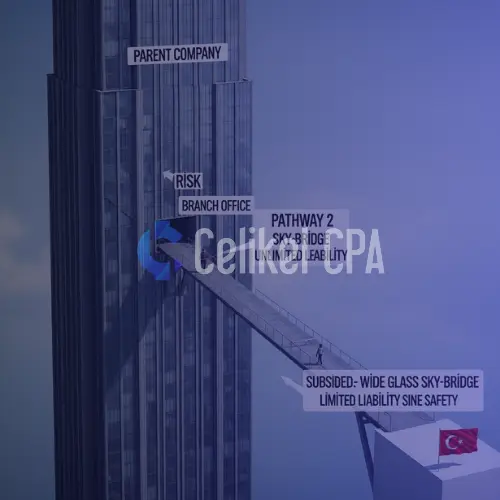
1. Parent-company responsibility A branch is not a separate legal person from its foreign parent. The parent is responsible for the branch’s obligations under applicable law. How a creditor can enforce a Turkish claim against assets in another country depends on the relevant jurisdiction and recognition procedures.
- Subsidiary comparison: A Turkish subsidiary is a separate legal entity, but its shareholders, directors or parent may still have statutory responsibilities or liabilities under guarantees and other arrangements. See our guide to foreign ownership of a Turkish LLC. 2. Limited Scope of Activity A branch is strictly limited to the fields of activity specified in the parent company’s articles of association. Even if it identifies a new business opportunity in the Turkish market, it cannot pursue it if it falls outside the parent’s defined scope. A new company (LLC/JSC) is far more flexible in this regard.
3. Market Perception and Localization Challenges The “strong brand” advantage can also be a disadvantage. In some cases (especially in public tenders or when dealing with local clients), the market may prefer to work with a “local Turkish company” rather than a “foreign extension.” A branch can be perceived as temporary or less committed to the local market.
4. Complex Tax Reporting A branch is subject to Corporate Tax in Turkey on its profits (just like an LLC). However, the repatriation of profits to the head office and the reporting of transactions between the head office and the branch (transfer pricing) can be complex and require a detailed examination of double taxation treaties.
Comparison Table: Branch Office vs. New Company (LLC/JSC)
| Feature | Branch Office | New Company (LLC / JSC) |
|---|---|---|
| Legal Entity | No. It is an extension of the parent company. | Yes. It is an independent Turkish company. |
| Liability | The branch is not separate from the foreign parent, which is responsible for its obligations. | Separate legal entity; shareholder, director, guarantee and public-debt rules may still apply. |
| Capital | No minimum capital requirement. | Minimum capital applies: TRY 50,000 for an LLC and TRY 250,000 for a JSC as of 2026. |
| Scope of Activity | Limited to the parent company’s registered field of activity. | Can operate across activities defined in its own articles of association. |
| Market Perception | Often viewed as a foreign extension and sometimes as a temporary market entry. | Seen as a local Turkish company with a longer-term investment posture. |
Conclusion: Is a Branch the Right Choice for You?
Opening a branch can suit a company that wants to operate directly under its foreign legal identity and accepts the parent-company responsibility that comes with that structure.
For a subsidiary, compare the separate legal personality against its capital, governance, tax and compliance requirements. Neither structure guarantees a particular liability outcome; choose after reviewing the planned activities, contracts and sector rules.
This decision will directly impact your global strategy, risk appetite, and objectives in Turkey.
For more information about setting up a company in Turkey, please visit our main service page: Company Formation in Turkey.
Tax Presence and Foreign Investment Follow-Up
Before choosing a branch, compare the registered structure with the broader permanent establishment rules in Turkey. A foreign-invested branch should also establish responsibility for applicable E-TUYS reporting after registration.
Need practical support in Turkey?
Discuss the accounting, tax, payroll, or company setup implications of your situation with a licensed local professional.
Frequently Asked Questions
Is a branch office a separate legal entity in Turkey?
No. A branch does not have a separate legal personality from its foreign parent. The parent is responsible for branch obligations; cross-border enforcement of a Turkish claim depends on the applicable law and recognition process.
What is the biggest risk of opening a branch instead of a company?
The parent company is responsible for branch obligations because the branch is not a separate legal person. A subsidiary is separate, but that does not eliminate liabilities arising under statute, director duties, guarantees or other arrangements.
Does a branch need minimum share capital?
No. Unlike an LLC at 50,000 TRY or a JSC at 250,000 TRY as of 2026, a branch has no statutory minimum capital. That is one reason it can be set up quickly and is sometimes used to test the market or run a single time-limited project.
Is a branch taxed differently from a Turkish company?
A branch pays Turkish corporate tax on its Turkey-sourced profits at the same rate as an LLC. The added complexity is in repatriating profit to the head office and in head-office-to-branch transactions, which raise transfer pricing and double taxation treaty questions that need careful handling.
When does a branch make more sense than forming a company?
A branch can suit a company that intends to operate under its foreign identity and has assessed parent-company responsibility, Turkish registration and sector-specific requirements. A subsidiary may suit a different governance or risk structure; compare the actual activities and obligations before deciding.